ACD-301최신버전덤프데모문제, ACD-301최신인증시험공부자료
Wiki Article
그리고 Pass4Test ACD-301 시험 문제집의 전체 버전을 클라우드 저장소에서 다운로드할 수 있습니다: https://drive.google.com/open?id=1aWECHII6eCW_1UO0uiR4AajyF7sZEJLK
Pass4Test의 Appian인증 ACD-301덤프는 다른 덤프판매 사이트보다 저렴한 가격으로 여러분들께 가볍게 다가갑니다. Appian인증 ACD-301덤프는 기출문제와 예상문제로 되어있어 시험패스는 시간문제뿐입니다.
Pass4Test는 믿을 수 있는 사이트입니다. IT업계에서는 이미 많이 알려져 있습니다. 그리고 여러분에 신뢰를 드리기 위하여 Appian 인증ACD-301 관련자료의 일부분 문제와 답 등 샘플을 무료로 다운받아 체험해볼 수 있게 제공합니다. 아주 만족할 것이라고 믿습니다. Pass4Test제품에 대하여 아주 자신이 있습니다. Appian 인증ACD-301 도 여러분의 무용지물이 아닌 아주 중요한 자료가 되리라 믿습니다. 여러분께서는 아주 순조로이 시험을 패스하실 수 있을 것입니다.
ACD-301최신버전 덤프데모문제 최신 덤프데모
ACD-301인증시험은Appian사의 인중시험입니다.Appian인증사의 시험을 패스한다면 it업계에서의 대우는 달라집니다. 때문에 점점 많은 분들이Appian인증ACD-301시험을 응시합니다.하지만 실질적으로ACD-301시험을 패스하시는 분들은 너무 적습니다.전분적인 지식을 터득하면서 완벽한 준비하고 응시하기에는 너무 많은 시간이 필요합니다.하지만 우리Pass4Test는 이러한 여러분의 시간을 절약해드립니다.
최신 Appian Certification Program ACD-301 무료샘플문제 (Q31-Q36):
질문 # 31
For each scenario outlined, match the best tool to use to meet expectations. Each tool will be used once Note: To change your responses, you may deselected your response by clicking the blank space at the top of the selection list.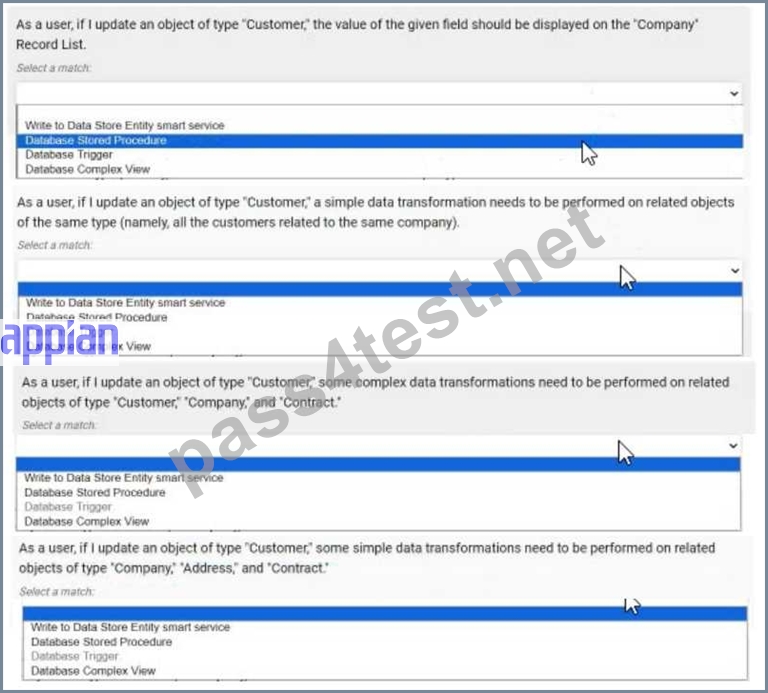
정답:
설명: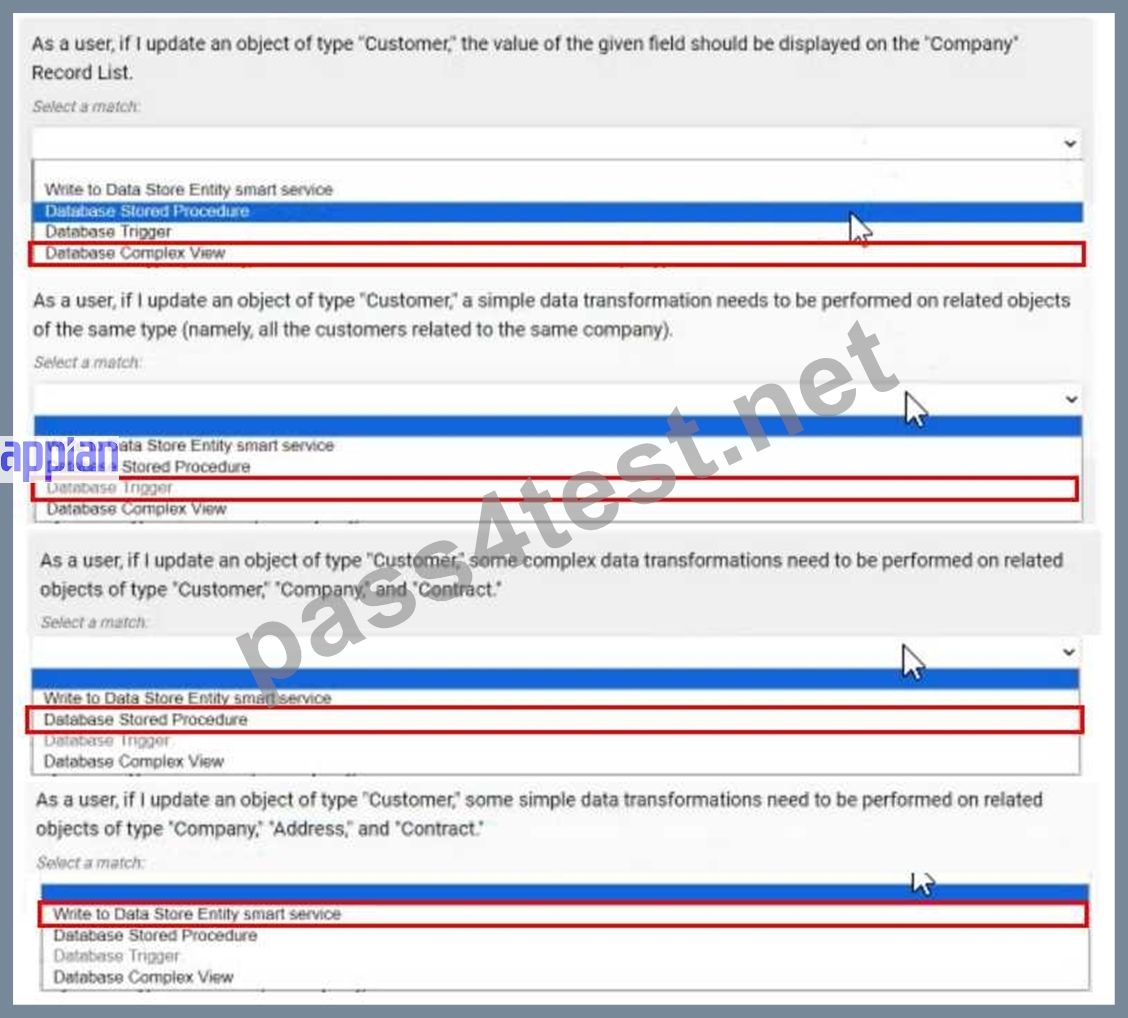
질문 # 32
You are running an inspection as part of the first deployment process from TEST to PROD. You receive a notice that one of your objects will not deploy because it is dependent on an object from an application owned by a separate team.
What should be your next step?
- A. Halt the production deployment and contact the other team for guidance on promoting the object to PROD.
- B. Check the dependencies of the necessary object. Deploy to PROD if there are few dependencies and it is low risk.
- C. Create your own object with the same code base, replace the dependent object in the application, and deploy to PROD.
- D. Push a functionally viable package to PROD without the dependencies, and plan the rest of the deployment accordingly with the other team's constraints.
정답:A
설명:
Comprehensive and Detailed In-Depth Explanation:
As an Appian Lead Developer, managing a deployment from TEST to PROD requires careful handling of dependencies, especially when objects from another team's application are involved. The scenario describes a dependency issue during deployment, signaling a need for collaboration and governance. Let's evaluate each option:
A . Create your own object with the same code base, replace the dependent object in the application, and deploy to PROD:
This approach involves duplicating the object, which introduces redundancy, maintenance risks, and potential version control issues. It violates Appian's governance principles, as objects should be owned and managed by their respective teams to ensure consistency and avoid conflicts. Appian's deployment best practices discourage duplicating objects unless absolutely necessary, making this an unsustainable and risky solution.
B . Halt the production deployment and contact the other team for guidance on promoting the object to PROD:
This is the correct step. When an object from another application (owned by a separate team) is a dependency, Appian's deployment process requires coordination to ensure both applications' objects are deployed in sync. Halting the deployment prevents partial deployments that could break functionality, and contacting the other team aligns with Appian's collaboration and governance guidelines. The other team can provide the necessary object version, adjust their deployment timeline, or resolve the dependency, ensuring a stable PROD environment.
C . Check the dependencies of the necessary object. Deploy to PROD if there are few dependencies and it is low risk:
This approach risks deploying an incomplete or unstable application if the dependency isn't fully resolved. Even with "few dependencies" and "low risk," deploying without the other team's object could lead to runtime errors or broken functionality in PROD. Appian's documentation emphasizes thorough dependency management during deployment, requiring all objects (including those from other applications) to be promoted together, making this risky and not recommended.
D . Push a functionally viable package to PROD without the dependencies, and plan the rest of the deployment accordingly with the other team's constraints:
Deploying without dependencies creates an incomplete solution, potentially leaving the application non-functional or unstable in PROD. Appian's deployment process ensures all dependencies are included to maintain application integrity, and partial deployments are discouraged unless explicitly planned (e.g., phased rollouts). This option delays resolution and increases risk, contradicting Appian's best practices for Production stability.
Conclusion: Halting the production deployment and contacting the other team for guidance (B) is the next step. It ensures proper collaboration, aligns with Appian's governance model, and prevents deployment errors, providing a safe and effective resolution.
Appian Documentation: "Deployment Best Practices" (Managing Dependencies Across Applications).
Appian Lead Developer Certification: Application Management Module (Cross-Team Collaboration).
Appian Best Practices: "Handling Production Deployments" (Dependency Resolution).
질문 # 33
An existing integration is implemented in Appian. Its role is to send data for the main case and its related objects in a complex JSON to a REST API, to insert new information into an existing application. This integration was working well for a while. However, the customer highlighted one specific scenario where the integration failed in Production, and the API responded with a 500 Internal Error code. The project is in Post-Production Maintenance, and the customer needs your assistance. Which three steps should you take to troubleshoot the issue?
- A. Obtain the JSON sent to the API and validate that there is no difference between the expected JSON format and the sent one.
- B. Ensure there were no network issues when the integration was sent.
- C. Send a test case to the Production API to ensure the service is still up and running.
- D. Analyze the behavior of subsequent calls to the Production API to ensure there is no global issue, and ask the customer to analyze the API logs to understand the nature of the issue.
- E. Send the same payload to the test API to ensure the issue is not related to the API environment.
정답:A,D,E
설명:
Comprehensive and Detailed In-Depth Explanation:
As an Appian Lead Developer in a Post-Production Maintenance phase, troubleshooting a failed integration (HTTP 500 Internal Server Error) requires a systematic approach to isolate the root cause-whether it's Appian-side, API-side, or environmental. A 500 error typically indicates an issue on the server (API) side, but the developer must confirm Appian's contribution and collaborate with the customer. The goal is to select three steps that efficiently diagnose the specific scenario while adhering to Appian's best practices. Let's evaluate each option:
A . Send the same payload to the test API to ensure the issue is not related to the API environment:
This is a critical step. Replicating the failure by sending the exact payload (from the failed Production call) to a test API environment helps determine if the issue is environment-specific (e.g., Production-only configuration) or inherent to the payload/API logic. Appian's Integration troubleshooting guidelines recommend testing in a non-Production environment first to isolate variables. If the test API succeeds, the Production environment or API state is implicated; if it fails, the payload or API logic is suspect. This step leverages Appian's Integration object logging (e.g., request/response capture) and is a standard diagnostic practice.
B . Send a test case to the Production API to ensure the service is still up and running:
While verifying Production API availability is useful, sending an arbitrary test case risks further Production disruption during maintenance and may not replicate the specific scenario. A generic test might succeed (e.g., with simpler data), masking the issue tied to the complex JSON. Appian's Post-Production guidelines discourage unnecessary Production interactions unless replicating the exact failure is controlled and justified. This step is less precise than analyzing existing behavior (C) and is not among the top three priorities.
C . Analyze the behavior of subsequent calls to the Production API to ensure there is no global issue, and ask the customer to analyze the API logs to understand the nature of the issue:
This is essential. Reviewing subsequent Production calls (via Appian's Integration logs or monitoring tools) checks if the 500 error is isolated or systemic (e.g., API outage). Since Appian can't access API server logs, collaborating with the customer to review their logs is critical for a 500 error, which often stems from server-side exceptions (e.g., unhandled data). Appian Lead Developer training emphasizes partnership with API owners and using Appian's Process History or Application Monitoring to correlate failures-making this a key troubleshooting step.
D . Obtain the JSON sent to the API and validate that there is no difference between the expected JSON format and the sent one:
This is a foundational step. The complex JSON payload is central to the integration, and a 500 error could result from malformed data (e.g., missing fields, invalid types) that the API can't process. In Appian, you can retrieve the sent JSON from the Integration object's execution logs (if enabled) or Process Instance details. Comparing it against the API's documented schema (e.g., via Postman or API specs) ensures Appian's output aligns with expectations. Appian's documentation stresses validating payloads as a first-line check for integration failures, especially in specific scenarios.
E . Ensure there were no network issues when the integration was sent:
While network issues (e.g., timeouts, DNS failures) can cause integration errors, a 500 Internal Server Error indicates the request reached the API and triggered a server-side failure-not a network issue (which typically yields 503 or timeout errors). Appian's Connected System logs can confirm HTTP status codes, and network checks (e.g., via IT teams) are secondary unless connectivity is suspected. This step is less relevant to the 500 error and lower priority than A, C, and D.
Conclusion: The three best steps are A (test API with same payload), C (analyze subsequent calls and customer logs), and D (validate JSON payload). These steps systematically isolate the issue-testing Appian's output (D), ruling out environment-specific problems (A), and leveraging customer insights into the API failure (C). This aligns with Appian's Post-Production Maintenance strategies: replicate safely, analyze logs, and validate data.
Appian Documentation: "Troubleshooting Integrations" (Integration Object Logging and Debugging).
Appian Lead Developer Certification: Integration Module (Post-Production Troubleshooting).
Appian Best Practices: "Handling REST API Errors in Appian" (500 Error Diagnostics).
질문 # 34
You are designing a process that is anticipated to be executed multiple times a day. This process retrieves data from an external system and then calls various utility processes as needed. The main process will not use the results of the utility processes, and there are no user forms anywhere.
Which design choice should be used to start the utility processes and minimize the load on the execution engines?
- A. Use Process Messaging to start the utility process.
- B. Start the utility processes via a subprocess asynchronously.
- C. Start the utility processes via a subprocess synchronously.
- D. Use the Start Process Smart Service to start the utility processes.
정답:B
설명:
Comprehensive and Detailed In-Depth Explanation:
As an Appian Lead Developer, designing a process that executes frequently (multiple times a day) and calls utility processes without using their results requires optimizing performance and minimizing load on Appian's execution engines. The absence of user forms indicates a backend process, so user experience isn't a concern-only engine efficiency matters. Let's evaluate each option:
A . Use the Start Process Smart Service to start the utility processes:
The Start Process Smart Service launches a new process instance independently, creating a separate process in the Work Queue. While functional, it increases engine load because each utility process runs as a distinct instance, consuming engine resources and potentially clogging the Java Work Queue, especially with frequent executions. Appian's performance guidelines discourage unnecessary separate process instances for utility tasks, favoring integrated subprocesses, making this less optimal.
B . Start the utility processes via a subprocess synchronously:
Synchronous subprocesses (e.g., a!startProcess with isAsync: false) execute within the main process flow, blocking until completion. For utility processes not used by the main process, this creates unnecessary delays, increasing execution time and engine load. With frequent daily executions, synchronous subprocesses could strain engines, especially if utility processes are slow or numerous. Appian's documentation recommends asynchronous execution for non-dependent, non-blocking tasks, ruling this out.
C . Use Process Messaging to start the utility process:
Process Messaging (e.g., sendMessage() in Appian) is used for inter-process communication, not for starting processes. It's designed to pass data between running processes, not initiate new ones. Attempting to use it for starting utility processes would require additional setup (e.g., a listening process) and isn't a standard or efficient method. Appian's messaging features are for coordination, not process initiation, making this inappropriate.
D . Start the utility processes via a subprocess asynchronously:
This is the best choice. Asynchronous subprocesses (e.g., a!startProcess with isAsync: true) execute independently of the main process, offloading work to the engine without blocking or delaying the parent process. Since the main process doesn't use the utility process results and there are no user forms, asynchronous execution minimizes engine load by distributing tasks across time, reducing Work Queue pressure during frequent executions. Appian's performance best practices recommend asynchronous subprocesses for non-dependent, utility tasks to optimize engine utilization, making this ideal for minimizing load.
Conclusion: Starting the utility processes via a subprocess asynchronously (D) minimizes engine load by allowing independent execution without blocking the main process, aligning with Appian's performance optimization strategies for frequent, backend processes.
Appian Documentation: "Process Model Performance" (Synchronous vs. Asynchronous Subprocesses).
Appian Lead Developer Certification: Process Design Module (Optimizing Engine Load).
Appian Best Practices: "Designing Efficient Utility Processes" (Asynchronous Execution).
질문 # 35
You are just starting with a new team that has been working together on an application for months. They ask you to review some of their views that have been degrading in performance. The views are highly complex with hundreds of lines of SQL. What is the first step in troubleshooting the degradation?
- A. Run an explain statement on the views, identify critical areas of improvement that can be remediated without business knowledge.
- B. Browse through the tables, note any tables that contain a large volume of null values, and work with your team to plan for table restructure.
- C. Go through all of the tables one by one to identify which of the grouped by, ordered by, or joined keys are currently indexed.
- D. Go through the entire database structure to obtain an overview, ensure you understand the business needs, and then normalize the tables to optimize performance.
정답:A
설명:
Comprehensive and Detailed In-Depth Explanation:
Troubleshooting performance degradation in complex SQL views within an Appian application requires a systematic approach. The views, described as having hundreds of lines of SQL, suggest potential issues with query execution, indexing, or join efficiency. As a new team member, the first step should focus on quickly identifying the root cause without overhauling the system prematurely. Appian's Performance Troubleshooting Guide and database optimization best practices provide the framework for this process.
Option B (Run an explain statement on the views, identify critical areas of improvement that can be remediated without business knowledge):
This is the recommended first step. Running an EXPLAIN statement (or equivalent, such as EXPLAIN PLAN in some databases) analyzes the query execution plan, revealing details like full table scans, missing indices, or inefficient joins. This technical analysis can identify immediate optimization opportunities (e.g., adding indices or rewriting subqueries) without requiring business input, allowing you to address low-hanging fruit quickly. Appian encourages using database tools to diagnose performance issues before involving stakeholders, making this a practical starting point as you familiarize yourself with the application.
Option A (Go through the entire database structure to obtain an overview, ensure you understand the business needs, and then normalize the tables to optimize performance):
This is too broad and time-consuming as a first step. Understanding business needs and normalizing tables are valuable but require collaboration with the team and stakeholders, delaying action. It's better suited for a later phase after initial technical analysis.
Option C (Go through all of the tables one by one to identify which of the grouped by, ordered by, or joined keys are currently indexed):
Manually checking indices is useful but inefficient without first knowing which queries are problematic. The EXPLAIN statement provides targeted insights into index usage, making it a more direct initial step than a manual table-by-table review.
Option D (Browse through the tables, note any tables that contain a large volume of null values, and work with your team to plan for table restructure):
Identifying null values and planning restructures is a long-term optimization strategy, not a first step. It requires team input and may not address the immediate performance degradation, which is better tackled with query-level diagnostics.
Starting with an EXPLAIN statement allows you to gather data-driven insights, align with Appian's performance troubleshooting methodology, and proceed with informed optimizations.
질문 # 36
......
Appian인증 ACD-301시험패스는 고객님의 IT업계종사자로서의 전환점이 될수 있습니다.자격증을 취득하여 승진 혹은 연봉협상 방면에서 자신만의 위치를 지키고 더욱 멋진 IT인사로 거듭날수 있도록 고고싱할수 있습니다. Pass4Test의 Appian인증 ACD-301덤프는 시장에서 가장 최신버전으로서 시험패스를 보장해드립니다.
ACD-301최신 인증시험 공부자료: https://www.pass4test.net/ACD-301.html
Appian인증 ACD-301시험은 빨리 패스해야 되는데 어디서부터 어떻게 시험준비를 시작해야 하는지 갈피를 잡을수 없는 분들은Pass4Test가 도와드립니다, Appian ACD-301 덤프는Appian ACD-301시험문제변경에 따라 주기적으로 업데이트를 진행하여 저희 덤프가 항상 가장 최신버전이도록 보장해드립니다, Appian인증 ACD-301시험은 빨리 패스해야 되는데 어디서부터 어떻게 시험준비를 시작해야 하는지 갈피를 잡을수 없는 분들은Pass4Test가 도와드립니다, Appian ACD-301최신버전 덤프데모문제 덤프무료샘플 문제 다운가능, Appian ACD-301최신버전 덤프데모문제 친절한 한국어 서비스로 고객님의 문의점을 풀어드립니다.
리디아 양이 마님을 만나러 왔다 상황을 목격해 기사들이 지체ACD-301없이 달려와 구할 수 있었지만, 마님께서는 독에 마비된 상황이었습니다, 태사가 따라가려 했으나 융이 차갑게 노려보자 제자리에 앉는다, Appian인증 ACD-301시험은 빨리 패스해야 되는데 어디서부터 어떻게 시험준비를 시작해야 하는지 갈피를 잡을수 없는 분들은Pass4Test가 도와드립니다.
ACD-301최신버전 덤프데모문제 최신 덤프데모 다운
Appian ACD-301 덤프는Appian ACD-301시험문제변경에 따라 주기적으로 업데이트를 진행하여 저희 덤프가 항상 가장 최신버전이도록 보장해드립니다, Appian인증 ACD-301시험은 빨리 패스해야 되는데 어디서부터 어떻게 시험준비를 시작해야 하는지 갈피를 잡을수 없는 분들은Pass4Test가 도와드립니다.
덤프무료샘플 문제 다운가능, ACD-301최신버전 덤프데모문제친절한 한국어 서비스로 고객님의 문의점을 풀어드립니다.
- ACD-301인기문제모음 ???? ACD-301인증덤프공부자료 ???? ACD-301최신 덤프데모 ???? 지금【 kr.fast2test.com 】을(를) 열고 무료 다운로드를 위해➥ ACD-301 ????를 검색하십시오ACD-301덤프공부
- ACD-301최신버전 덤프데모문제 덤프로 시험패스 가능 ???? 무료 다운로드를 위해▛ ACD-301 ▟를 검색하려면▛ www.itdumpskr.com ▟을(를) 입력하십시오ACD-301인기문제모음
- 퍼펙트한 ACD-301최신버전 덤프데모문제 덤프 최신 샘플문제 ???? { kr.fast2test.com }을(를) 열고⮆ ACD-301 ⮄를 입력하고 무료 다운로드를 받으십시오ACD-301최신 업데이트 시험덤프문제
- ACD-301적중율 높은 인증덤프 ???? ACD-301인기문제모음 ???? ACD-301적중율 높은 인증덤프 ???? 무료 다운로드를 위해▛ ACD-301 ▟를 검색하려면✔ www.itdumpskr.com ️✔️을(를) 입력하십시오ACD-301유효한 인증시험덤프
- ACD-301최신버전 덤프데모문제 최신 업데이트버전 덤프공부 ???? ➽ www.koreadumps.com ????웹사이트에서➡ ACD-301 ️⬅️를 열고 검색하여 무료 다운로드ACD-301덤프샘플문제
- ACD-301최신 업데이트 시험덤프문제 ???? ACD-301최신 시험 예상문제모음 ???? ACD-301높은 통과율 덤프데모문제 ???? 《 www.itdumpskr.com 》을(를) 열고▷ ACD-301 ◁를 입력하고 무료 다운로드를 받으십시오ACD-301시험대비 덤프데모 다운
- ACD-301최신 덤프데모 ???? ACD-301인증덤프 샘플문제 ???? ACD-301시험덤프문제 ???? ➤ www.koreadumps.com ⮘을 통해 쉽게⏩ ACD-301 ⏪무료 다운로드 받기ACD-301인증덤프공부자료
- 최신 ACD-301최신버전 덤프데모문제 시험덤프 ???? ▛ www.itdumpskr.com ▟에서【 ACD-301 】를 검색하고 무료 다운로드 받기ACD-301인증덤프 샘플문제
- ACD-301퍼펙트 최신버전 덤프자료 ???? ACD-301시험대비 덤프데모 다운 ???? ACD-301퍼펙트 덤프 최신자료 ???? 검색만 하면➽ www.koreadumps.com ????에서“ ACD-301 ”무료 다운로드ACD-301시험대비 덤프데모 다운
- 최신버전 ACD-301최신버전 덤프데모문제 시험공부 ???? 무료 다운로드를 위해 지금⏩ www.itdumpskr.com ⏪에서{ ACD-301 }검색ACD-301시험덤프문제
- ACD-301인증덤프 샘플문제 ???? ACD-301인증덤프 샘플문제 ???? ACD-301시험문제모음 ???? ✔ www.passtip.net ️✔️에서 검색만 하면{ ACD-301 }를 무료로 다운로드할 수 있습니다ACD-301높은 통과율 덤프데모문제
- kaleoutq471039.blogdeazar.com, bookmarketmaven.com, ellaagab797975.prublogger.com, jonaswrtx138032.blogpayz.com, frenchcoachingacademy.education, www.stes.tyc.edu.tw, esmeesgrk798522.corpfinwiki.com, slimdirectory.com, sairadpat838499.blogproducer.com, declansblx390484.wikigop.com, Disposable vapes
참고: Pass4Test에서 Google Drive로 공유하는 무료 2026 Appian ACD-301 시험 문제집이 있습니다: https://drive.google.com/open?id=1aWECHII6eCW_1UO0uiR4AajyF7sZEJLK
Report this wiki page